

Author: Shelby Benavidez
Contributing Attorney: Brad Russell, attorney
Defining and Understanding Right-of-Way
What Does Yielding the Right-of-Way Mean?
The term “right-of-way” refers to the legal right of a driver, pedestrian, or cyclist to go first in certain traffic situations. Yielding the right-of-way, letting someone else move ahead of you to avoid a car accident, may sound like a simple and polite gesture, but it’s also a rule required by state and local traffic laws.
Failure to yield the right-of-way can lead to a traffic ticket and be grounds for liability in a civil lawsuit. In short, the law requires drivers to yield in order to keep traffic safe and running smoothly.
Which Vehicles Have the Right-of-Way?
Right-of-way is situational and determined by law or traffic controls. For example, at intersections without signals, it’s typically first-come, first-served, meaning the vehicle that arrives first gets to proceed first. If two vehicles arrive at the same time, the vehicle on the righthas priority. In a “T” intersection, vehicles on the main road always have the right-of-way over those entering from the intersecting street.
In signal-controlled intersections, a green light authorizes a vehicle to go forward, turn left, or right, but only if the intersection is clear of other vehicles, pedestrians, and emergency vehicles. When making left turns or U-turns, drivers must yield to oncoming traffic unless directed otherwise by a signal, such as a green arrow.
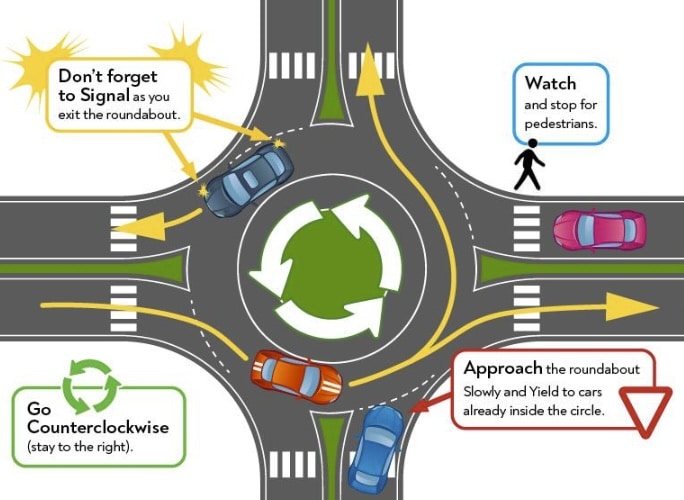
Roundabouts operate under a rule that grants right-of-way to vehicles already circulating within the circle, requiring incoming drivers to wait until it’s safe to enter. Similarly, on highways and freeways, drivers merging from entrance ramps must yield to traffic already traveling on the main road, though exit ramps do not give merging vehicles priority to re-enter the freeway.
Emergency vehicles using sirens or flashing lights always have the right-of-way. All other drivers are required by law to move to the right and stop, if safe, to allow passage.
When Should You Yield Your Legal Right-of-Way?
Even if you technically have the right-of-way, that doesn’t mean you should keep going if it’s clearly unsafe. Drivers still need to pay attention to what’s happening around them. For example, a green light doesn’t give someone the right to drive into a pedestrian who is already in the crosswalk. The same goes for intersections – just because it’s your turn to go doesn’t mean another driver won’t make a mistake.
Pedestrian Rights and Yielding Obligations
Do Pedestrians Always Have the Right-of-Way?
Pedestrians are given strong legal protections, especially in crosswalks and at intersections. In most cases, drivers must yield to them. That said, pedestrians still have to follow traffic signals. If someone crosses against a red light or unexpectedly steps into traffic, they could be partly at fault for an accident.
Many states require drivers to exercise due care to avoid colliding with pedestrians, regardless of whether the pedestrian is in the right. Still, pedestrians do not have blanket priority in all circumstances. For example, jaywalking or walking while impaired could reduce a pedestrian’s legal standing in a civil lawsuit. Courts may consider these actions as contributing factors to any resulting accident.
Can Cyclists Have the Right-of-Way?
Cyclists are treated like vehicles under the law and must follow the same traffic rules as drivers. This includes stopping at signals, yielding when required, and riding in the same direction as traffic. When in a bike lane or going with traffic, cyclists have the same right-of-way as cars.
Just like drivers of vehicles, cyclists are required to yield to pedestrians in crosswalks and at intersections. If they fail to yield and collide with the pedestrian, they can receive a ticket or be held legally responsible for any injuries. Cyclists need to be extremely cautious because they don’t have the same protection as a vehicle. Ignoring traffic laws obviously puts others at risk, but cyclists can be severely injured in a crash due to the risk of being thrown from the bike.
What Happens Legally After a Failure to Yield Accident?
If someone causes a crash by failing to yield right-of-way, they can face hefty financial and legal consequences. Police will typically check the scene to create a crash report and may give a citation to the driver at fault. These reports are crucial for insurance claims and any legal action that follows because the insurance companies and attorneys will review the police report and supporting evidence to determine liability.
If someone is hurt or there’s excessive property damage, the driver at fault could be sued for negligence. In extreme cases of negligence, such as someone being severely injured or killed, or if alcohol is involved, the driver could face criminal charges like reckless driving or even intoxicated manslaughter.
Texas Right-of-Way Laws and Your Legal Rights
Understanding Texas Transportation Code § 545.153
In Texas, right-of-way rules can be found in the Texas Transportation Code, Section 545.153. This law explains when drivers must yield, such as at intersections, when coming from a driveway, or when merging onto highways.
Drivers must yield to traffic on the main road when entering from a driveway or alley and must also yield to vehicles coming from the right at intersections without signs or signals. When merging onto a highway, drivers must wait for a safe opening. Breaking this law is a moving violation and can lead to fines, points on your license, and higher insurance rates.
How Texas Law Applies in Accident Liability
Texas uses a rule called modified comparative fault. This means you can only get money in a lawsuit if you were less than 51% responsible for the accident. If you’re more than 50% at fault, you can’t collect any compensation.
For example, if a driver making a left turn doesn’t yield and is hit by a speeding car, both drivers might share the blame. The turning driver may be mostly at fault, but the speeding driver could still be partly responsible, which might lower the amount they can claim or increase their share of the blame. This rule encourages drivers to be careful, yield when needed, and not rely solely on having the right-of-way.
Contacting a Texas Car Accident Attorney
If you’ve been involved in a failure to yield the right-of-way accident, speaking with a qualified Texas car accident attorney is one of the most important steps you can take. Even if the accident seems straightforward, insurance companies may try to minimize your claim or shift some of the blame onto you, which can significantly reduce your potential settlement or prevent you from recovering damages altogether.
An experienced car accident attorney can help protect your rights by gathering key evidence such as police reports, witness statements, and traffic camera footage. They can also deal directly with insurance adjusters, making sure that your words aren’t twisted to be used against you. If needed, your attorney can file a lawsuit on your behalf and represent you in court, working to prove the other party’s negligence and maximize your compensation for medical bills, lost wages, property damage, and pain and suffering.
FAQs About Right-of-Way Laws
Who has the right-of-way at a four-way stop?
At a four-way stop, the vehicle that arrives first generally has the right-of-way and may proceed first. If two vehicles arrive at the same time, the driver on the left must yield to the driver on the right. Drivers making left turns must also yield to vehicles traveling straight or turning right.
Who has the right-of-way when turning left?
A driver making a left turn must yield to oncoming traffic that is traveling straight through the intersection or turning right. The left-turning driver should wait until there is a safe gap before completing the turn unless a green arrow or traffic officer indicates otherwise.
Who has the right-of-way when entering a highway?
Drivers entering a highway or freeway from an entrance ramp must yield to traffic already traveling on the roadway. Merging drivers should adjust their speed and wait for a safe gap before entering the flow of traffic.
Do emergency vehicles always have the right-of-way?
Yes. Emergency vehicles using sirens or flashing lights have the right-of-way in all situations. Drivers must move to the right side of the road and stop, if it is safe to do so, until the emergency vehicle has passed.
Can you still be at fault even if you had the right-of-way?
Yes. Even if a driver technically has the right-of-way, they may still share fault if they failed to act reasonably to avoid a crash. Under Texas’s modified comparative fault rule, compensation may be reduced based on a person’s percentage of responsibility.
What should you do after a failure-to-yield accident?
After a failure-to-yield accident, you should call the police, seek medical attention, document the scene, and exchange information with the other driver. It may also be helpful to speak with a car accident attorney who can review the evidence and help determine liability.